What Is Algorithmic Trading? How Software Now Runs the Markets
- July 21, 2026
- Trading , what is algorithmic trading
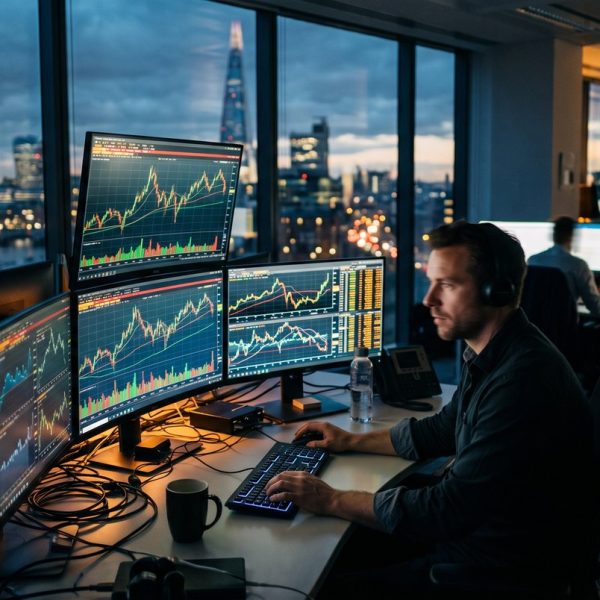
Walk onto a modern trading floor and the first thing you notice is how quiet it is. The shouting and paper tickets are long gone, replaced by rows of screens and the low hum of servers. Most of the buying and selling now happens without a human touching a button at the moment of the trade. That shift has a name, and if you have ever wondered what is algorithmic trading, the simple version is trading carried out by computer programs following a predefined set of rules, at speeds and volumes no person could match.
This is not a niche corner of finance. By most estimates, algorithms drive the majority of trading volume in major stock and currency markets. Understanding how they work has become part of understanding the markets themselves.
What is algorithmic trading, in practice?
An algorithm is really just a recipe. In trading, that recipe might say something like: if a stock's price crosses above its fifty day average and volume is rising, buy a set amount, then sell when the price climbs two percent or falls one percent. Once those rules are written in code, the program watches the market and acts the instant its conditions are met, without hesitation, fatigue or second guessing.
The rules can be simple or fiendishly complex. Some strategies react to price patterns, others to news, order flow or tiny gaps between related assets. What they share is that the decision to trade is made by logic written in advance, not by a person reacting in the heat of the moment.
The building blocks: bots and backtests
Two ideas come up constantly. The first is the trading bot, the running program that connects to a broker or exchange and places orders automatically. A trading bot is only as good as the strategy inside it, and a poorly designed one can lose money just as tirelessly as a good one makes it.
The second is backtesting. Before risking real money, developers run their rules against years of historical data to see how the strategy would have performed. Knowing what is backtesting in trading is essential, because it is the closest thing to a reality check a strategy gets. It is also easy to fool yourself: a strategy tuned too perfectly to the past often falls apart in live markets, a trap known as overfitting.
Common approaches
Algorithmic strategies come in families. Trend following rides momentum. Arbitrage exploits fleeting price differences. A mean reversion trading strategy bets that prices stretched far from their average will snap back toward it. High frequency trading, the fastest and most controversial branch, competes on millionths of a second and lives or dies by the speed of its infrastructure. None of these is a guaranteed winner, and each carries its own risks.
The same discipline applies to the spoken side of a trading firm's work. Desks in London, Frankfurt, and Singapore sit on the same investor calls and compliance reviews, and a misunderstood phrase there can be as costly as an error in a filing. Many firms therefore rely on business translation services that extend to remote interpreting for cross-border calls, so what is agreed out loud and what is filed afterwards say exactly the same thing. It is a quieter kind of risk control, but for firms operating across languages it is just as essential as any circuit breaker.
Automated trading firms operate across venues with different disclosure regimes, and their compliance documentation has to say precisely the same thing in every language it appears in. Meeting that bar is the everyday work of financial translation services rather than an occasional special project. Regulatory language leaves very little room for interpretation, which is exactly the point.
Why the plumbing matters
Because these systems act in milliseconds, the infrastructure underneath them is not an afterthought. Reliable data feeds, low latency connections and resilient servers can matter as much as the strategy itself. A brilliant algorithm on a slow or unstable platform is a liability. Platforms that serve traders across borders also have to handle sensitive account and compliance documents in many languages, and doing that safely means knowing whether it is safe to translate confidential documents with AI or whether human oversight is required.
Automated systems concentrate activity in a few financial centres, which has a real effect on where specialists live. Sydney dominates that industry in Australia. Professionals who visit brisbane often note how much further a salary goes a few hundred miles north.
The upside, and the hidden costs
Done well, algorithmic trading brings real advantages. It strips emotion out of decisions, executes far faster and more precisely than a human hand, and can watch dozens of markets at once around the clock. For large institutions it also lowers the cost of moving big orders without spooking the market. But the same automation that removes human error can multiply a mistake in seconds, as flash crashes have shown, when interacting algorithms briefly sent prices into freefall. Speed cuts both ways. A rule that misreads an unusual event can rack up losses far quicker than any person could intervene, which is why serious operators build in circuit breakers and strict risk limits rather than simply trusting the code to behave.
A reality check for everyday investors
It is easy to read all this and assume algorithms are a shortcut to easy money. They are not. Building a profitable system takes real skill in both markets and code, most retail attempts lose money, and the field is fiercely competitive. For most people saving for the long term, boring tends to beat clever, which is why low cost index funds quietly outperform the majority of active traders over time.
If you want to understand the mechanics more deeply, solid overviews exist in the technical literature and in finance references such as Investopedia. This article is meant to explain how algorithmic trading works, not to recommend it as a way to invest, and nothing here is financial advice. What is clear is that the markets now run on code, and the people who understand that code, and its limits, are the ones who navigate them with clear eyes.